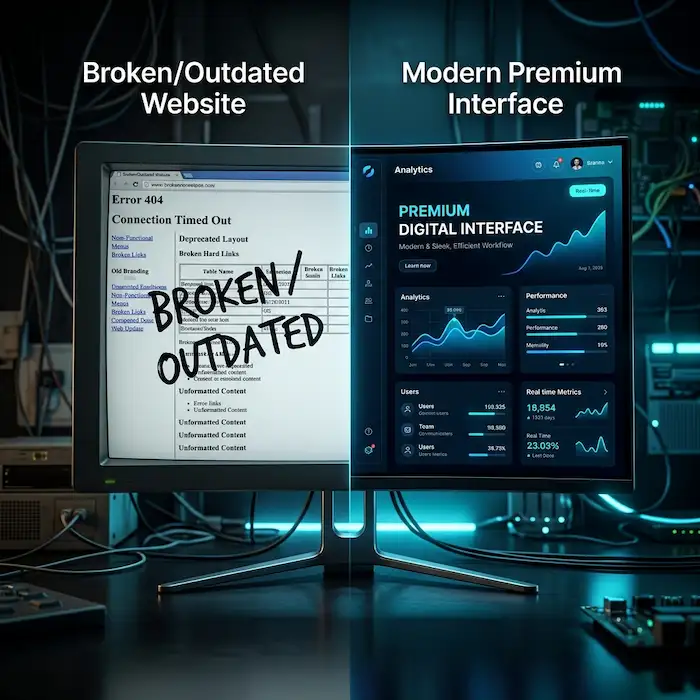
Something happens every day that very few business owners notice: a potential customer looks for you on Google, arrives at your page, looks at it for three seconds... and closes the tab. Without leaving their number. Without writing to you. Without coming back.
You won't know it. There's no notification for that. Simply, that customer never existed for you.
And the most unsettling part is that this customer does exist. They found your competition. They bought from them.
The problem is not that you don't have customers
Many businesses already have a website. But having a website is not the same as having a website that works. The difference between the two can be the difference between a business that grows and one that survives solely on recommendations.
A poorly made website is not neutral. It's not just a useless asset that no one visits. It is actively harmful: it generates a negative first impression, communicates disorder, and tells your potential customer that you probably run your business the same way.
That judgment occurs in less than a second. Before they read a single word of what you offer.
The signs that give away a website that drives away customers
It's not always obvious. Sometimes you're so used to seeing your own page that you stop noticing what a stranger notices immediately. Here are the most common signs:
It takes too long to load
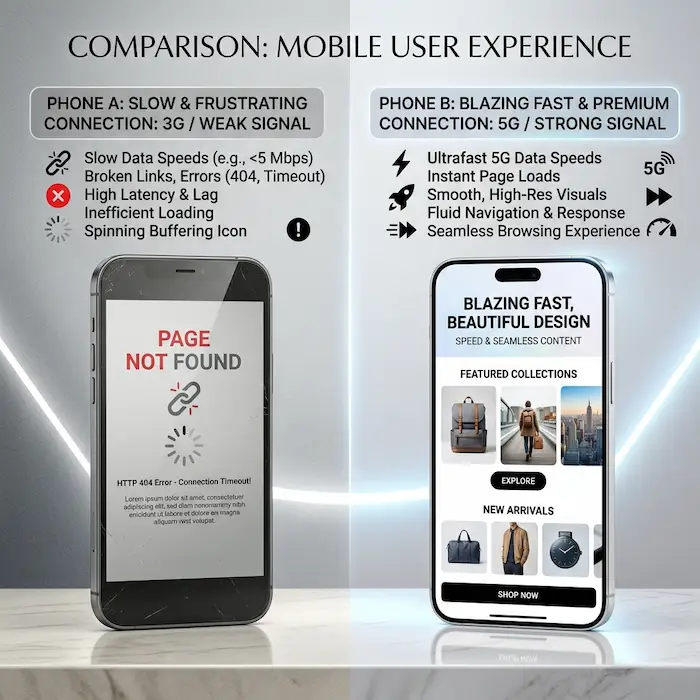
53% of mobile users abandon a page if it takes more than three seconds to load. Three seconds. And most small business pages take between six and twelve seconds, especially on mobile networks where most of your market connects. Each additional second of loading is a leak of potential customers that you will never recover.
It doesn't look good on mobile
More than 70% of web traffic comes from a smartphone. If your page was designed several years ago or simply wasn't thought out for mobile, your users are seeing tiny text, buttons that don't work, and forms that don't fit on the screen. It's frustrating. No one tolerates that frustration when there's another option just a click away.
It doesn't make clear what your business does
We arrive at pages where, after reading three paragraphs, we still don't know what they sell or who they sell to. The user is not going to decipher your business: if they don't understand it in the first five seconds, they leave. A page that works says exactly what you offer, for whom, and why to choose you, from the first glance.
It doesn't have a clear action
The user arrives, reads, is interested... and doesn't know what to do next. Do I call? Do I write? Is there a form? Where? A page without a clear call to action is like a salesman who does the whole presentation and at the end doesn't ask for the sale. All that effort for nothing.
It looks abandoned
Outdated dates. Photos with stock watermarks. "Coming soon" information that has been there for years. These details communicate one thing: that no one cares enough to keep this updated. And if you don't care about your own page, why would a new customer care about your business?
of users don't return to a page with a bad experience
is the maximum time a mobile user waits
judge credibility by design before reading anything
What your business loses in real numbers
Let's talk about something concrete. Imagine you own a dental clinic. Your page receives 300 visits a month from Google. If your conversion rate is 1% due to a bad experience, you're getting 3 contacts. With an optimized page, that same rate can reach 4 or 5%, that is, between 12 and 15 contacts from the same traffic.
Multiply that by the value of each new customer for your business. Multiply that by twelve months. That is the real cost of continuing with a website that doesn't work.
You don't have to bring more people to your page. You have to stop losing the ones who already arrive.
Why many businesses stick with the same old page
The most common answer we hear is: "I already have a page, so it's not a priority." And it has some logic. If you already have one, you've covered the box. The problem is that this box is not called "having a website". It's called "having a digital presence that generates customers". And that's where things change completely.
Others say it cost them a lot the first time and they don't want to invest again without guarantees. It's a valid fear, especially if the previous experience was paying dearly for something that didn't work. That's why it matters to work with someone who understands that the goal is not to deliver a page, but to deliver measurable results.
What your website should actually do
A professional website is not a digital ornament. It is a sales tool that works 24 hours a day, 7 days a week, while you attend to your business, sleep, or are doing something else.
It should load in less than two seconds on any device. It should communicate in the first seconds who you are, what you offer, and why to trust you. It should have a clear path for the visitor to become a contact, an appointment, a customer. And it should reflect the real quality of what you offer, not contradict it.
Is your page working?
We analyze your current site and tell you exactly what is costing you customers. No cost, no obligation.
Request free analysis